VIDEOS
AVAILABLE FOR RENTAL:
Click on image to watch 3-minute sample of video.
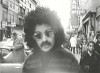
The Mythic
Being (1973; 00:08:00):
an excerpted segment from a film, Other Than Art's Sake by the
Australian artist Peter Kennedy, this is a hilarious documentation and
interview by Peter on my Mythic Being street performances. It shows me
getting into and out of drag, rehearsing my mantra, and roaming the streets
muttering it, followed by crowds of curious onlookers who are attracted
by Peter's film equipment and technicians.
Other Than Art's Sake also includes work by and interviews
with Ian Breakwell, Judy Chicago and Arlene Raven, Hans Haacke, David
Medalla, Charles Simonds, and Stephen Willats. For more information, contact
Peter Kennedy/ 48 Little Walker Lane, Clifton Hill/ Melbourne, Victoria, 3068/ Australia; telephone +61-3-
9481-0829 from 7:30 AM to 11 PM Australian
Eastern Standard Time.
 Funk Lessons (1983; 00:15:17):
a videotape piece based on an audience-interactive performance of Funk
Lessons at the University of California, Berkeley that goes considerably
beyond the performance. Both performance and tape address the ambiguous
status of African-American working class music and dance as serious contributors
to American art and culture. In the performance I teach my audience how
to listen to this music and how to dance to it. There's a lot of audience
response in this tape, which is humorous and also moving. Edited and directed
by Sam Samore, produced by Tom Oden. For a more recent, international
approach to the same material, I highly recommend the stately but endearing
Finnish/German/ Russian treatment at
http://folk.uio.no/tsandvik/fun/learn_disco.mpg
Funk Lessons (1983; 00:15:17):
a videotape piece based on an audience-interactive performance of Funk
Lessons at the University of California, Berkeley that goes considerably
beyond the performance. Both performance and tape address the ambiguous
status of African-American working class music and dance as serious contributors
to American art and culture. In the performance I teach my audience how
to listen to this music and how to dance to it. There's a lot of audience
response in this tape, which is humorous and also moving. Edited and directed
by Sam Samore, produced by Tom Oden. For a more recent, international
approach to the same material, I highly recommend the stately but endearing
Finnish/German/ Russian treatment at
http://folk.uio.no/tsandvik/fun/learn_disco.mpg
 My Calling (Card) #1 Meta-Performance (1987-88; 00:58:00):
documentary footage edited together from two audience-participatory meta-performances,
the first with an all-white audience, the second with a mixed but predominantly
black audience. I call them meta-performances because in them I
invite a larger audience into self-reflective participatory critique of
a one-on-one interpersonal performance for which I present documentation.
In this case, the one-on-one performance was of My Calling (Card) #1.
The first meta-performance, at the Randolph Street Gallery in Chicago
in 1987, took that performance as the object of critique. The second meta-performance,
at the Studio Museum in Harlem, took the Randolph Street Gallery meta-performance
as the object of critique. In that performance I suggest that whoever
watches the tape edited from these two meta-performances will be participating
in a third level of self-conscious meta-performance, taking the combined
tape itself as the object of critique. The level of audience engagement
in both venues was very high and the discussion quite heated. Interesting
dynamics developed between black and white participants in the Studio
Museum venue.
My Calling (Card) #1 Meta-Performance (1987-88; 00:58:00):
documentary footage edited together from two audience-participatory meta-performances,
the first with an all-white audience, the second with a mixed but predominantly
black audience. I call them meta-performances because in them I
invite a larger audience into self-reflective participatory critique of
a one-on-one interpersonal performance for which I present documentation.
In this case, the one-on-one performance was of My Calling (Card) #1.
The first meta-performance, at the Randolph Street Gallery in Chicago
in 1987, took that performance as the object of critique. The second meta-performance,
at the Studio Museum in Harlem, took the Randolph Street Gallery meta-performance
as the object of critique. In that performance I suggest that whoever
watches the tape edited from these two meta-performances will be participating
in a third level of self-conscious meta-performance, taking the combined
tape itself as the object of critique. The level of audience engagement
in both venues was very high and the discussion quite heated. Interesting
dynamics developed between black and white participants in the Studio
Museum venue.
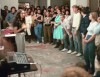 Funk Lessons Meta-Performance (1987; 00:42:00):
a re-edited documentary of a meta-performance at the Randolph Street Gallery
in Chicago that discusses the motivational, cultural and situational origins
of Funk Lessons, and analyzes the structure of the performance. Dialogue
with the all-white audience is extensive, very intense and occasionally
humorous.
Funk Lessons Meta-Performance (1987; 00:42:00):
a re-edited documentary of a meta-performance at the Randolph Street Gallery
in Chicago that discusses the motivational, cultural and situational origins
of Funk Lessons, and analyzes the structure of the performance. Dialogue
with the all-white audience is extensive, very intense and occasionally
humorous.
I am deeply indebted to Peter Kennedy, Sam Samore, Tom Oden, The Randolph Street Gallery, and The Studio Museum in Harlem for capturing some of my early performance work on videotape at a time when I did not have the resources to do so myself.
 Merge (1988, LED Billboard; 00:0:56, endless loop):
a short animation on the Times Square lightboard, a meditation on miscegenation,
procreation and self-transcendence using PacMan cartoon imagery.
Merge (1988, LED Billboard; 00:0:56, endless loop):
a short animation on the Times Square lightboard, a meditation on miscegenation,
procreation and self-transcendence using PacMan cartoon imagery.
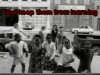 Please, God (1990; 00:61:00 endless loop):
a durational, three-part endless loop videotape combining footage of a
group of eight- or nine-year-old black girls joyfully dancing for the
camera in front of a window, a repeating text that moves slowly across
the top of the screen and expresses apprehension about the treatment they
will encounter as adults, and a music soundtrack consisting in three repeating
Billie Holiday songs, "God Bless the Child," "Stormy Blues,"
and "Strange Fruit."
Please, God (1990; 00:61:00 endless loop):
a durational, three-part endless loop videotape combining footage of a
group of eight- or nine-year-old black girls joyfully dancing for the
camera in front of a window, a repeating text that moves slowly across
the top of the screen and expresses apprehension about the treatment they
will encounter as adults, and a music soundtrack consisting in three repeating
Billie Holiday songs, "God Bless the Child," "Stormy Blues,"
and "Strange Fruit."
 Art Talk: Xenophobia and the Indexical Present (1993;
01:22:00):
a talk about my art work from 1968 to 1988 at Seminole Community College in Florida. I
try to show, through discussion of my own work, how art
can function in resisting or transforming the xenophobic
response that is cognitively inherent in everyone. This
talk ends rather suddenly, but contains a lot of jokes.
It may be of interest to institutions in the United
States at which I have had to decline invitations to
speak, because of my status as a Suspicious Traveler on
the U. S. Transportation Security Administration’s Watch List.
Art Talk: Xenophobia and the Indexical Present (1993;
01:22:00):
a talk about my art work from 1968 to 1988 at Seminole Community College in Florida. I
try to show, through discussion of my own work, how art
can function in resisting or transforming the xenophobic
response that is cognitively inherent in everyone. This
talk ends rather suddenly, but contains a lot of jokes.
It may be of interest to institutions in the United
States at which I have had to decline invitations to
speak, because of my status as a Suspicious Traveler on
the U. S. Transportation Security Administration’s Watch List.
 You/Stop/Watch: A Shiva Japam (August 2002; 00:42:26):
A real-time endurance piece about endurance. Formally referencing the
CNN talking head + multiple texts video format, this work is structured
by the yogic practice of japam, the continued repetition of a mantra that
restructures the neurological pathways of the brain in preparation for
the experience of death. This japam is dedicated to Shiva, the outsider,
the dancer, the yogic ascetic, the destroyer of illusion and so finally
the messenger of truth. The soundtrack is Raga Malkaus, played
by Prof. Roy Choudhury (Nataraj Music, Düsseldorf).
You/Stop/Watch: A Shiva Japam (August 2002; 00:42:26):
A real-time endurance piece about endurance. Formally referencing the
CNN talking head + multiple texts video format, this work is structured
by the yogic practice of japam, the continued repetition of a mantra that
restructures the neurological pathways of the brain in preparation for
the experience of death. This japam is dedicated to Shiva, the outsider,
the dancer, the yogic ascetic, the destroyer of illusion and so finally
the messenger of truth. The soundtrack is Raga Malkaus, played
by Prof. Roy Choudhury (Nataraj Music, Düsseldorf).
 Shiva Dances with the Art Institute of Chicago
(October 2004; 01:43:18): Structured by a Fall 2003 lecture at the Art Institute
of Chicago that transformed into a spontaneous and moving group performance,
I situate Funk Lessons first in the evolving tradition of recent
mainstream films that highlight the teaching of popular dance as a medium
of self-transcendence and cross-cultural contact; and second within the
broader philosophical context of The Color Wheel Series, which
this video completes.
Shiva Dances with the Art Institute of Chicago
(October 2004; 01:43:18): Structured by a Fall 2003 lecture at the Art Institute
of Chicago that transformed into a spontaneous and moving group performance,
I situate Funk Lessons first in the evolving tradition of recent
mainstream films that highlight the teaching of popular dance as a medium
of self-transcendence and cross-cultural contact; and second within the
broader philosophical context of The Color Wheel Series, which
this video completes.
Imitation of Life
(1934)
Passing Beyond Passing (November 2004; 01:38:27.
Lecture/Screening/Discussion):
Why is America’s caste system so intractable? It is because of the deep connection between racial stereotyping
and gluttony in the United States. The video combines six film clips from forgotten Hollywood movies that
engage
the issue of passing, with a video documentation of my video installation Cornered (1988), and a
lecture
excerpted from my manuscript in progress, Recognition and Responsibility: The Presence of the Past in
Germany, Australia and the United States, that was delivered and discussed with the audience at the Haus
der Kulturen der Welt, Berlin in November 2004. This video premieres at the IHME Contemporary Art Festival,
Helsinki in April 2014, during the IHME Days. It presents my considered analysis of American racism, and
documents the last time I intend to speak publicly about it.
 Unite
(2005; 00:39:00. Part I of the PacMan Trilogy; video wall projection. Video animation by Colin Holgate of
Funnygarbage):
This anti-pack-mentality deprogrammer, schematizes my
extensive empirical experience with packs – white packs,
black packs, gray packs, male packs, female packs, straight
packs, gay packs, ethnic packs, religious packs, art packs,
philosophy packs, professional packs, social packs,
institutional packs, outsider packs – over the last five
decades. It models the idealized, limiting case in which the
number of originating members of the pack is finite and
stipulated, and therefore can diminish progressively to zero.
In reality, new recruits to the pack are continually being
procreated (see Merge, 1988), programmed and inducted, as
unsuitable members are rooted out; thus continually
replenishing pack membership in an unlimited series that
extends indefinitely into both past and future.
Unite
(2005; 00:39:00. Part I of the PacMan Trilogy; video wall projection. Video animation by Colin Holgate of
Funnygarbage):
This anti-pack-mentality deprogrammer, schematizes my
extensive empirical experience with packs – white packs,
black packs, gray packs, male packs, female packs, straight
packs, gay packs, ethnic packs, religious packs, art packs,
philosophy packs, professional packs, social packs,
institutional packs, outsider packs – over the last five
decades. It models the idealized, limiting case in which the
number of originating members of the pack is finite and
stipulated, and therefore can diminish progressively to zero.
In reality, new recruits to the pack are continually being
procreated (see Merge, 1988), programmed and inducted, as
unsuitable members are rooted out; thus continually
replenishing pack membership in an unlimited series that
extends indefinitely into both past and future.
 The Spurious Life-Death Distinction
(2006; 00:45:00. Part II of the PacMan Trilogy; video wall projection. Video animation by Colin Holgate of
Funnygarbage):
The life-death distinction depends on outdated assumptions
about the nature of consciousness as equivalent to sentience.
This is implausible. Speculative theoretical physics and
Vedanta concur in equating consciousness with energy. Since
energy obeys the law of the conservation of energy,
consciousness is conserved throughout the cycle of growth and
decay, expansion and contraction, order and entropy, life and
“death”. Consciousness does not die; it merely undergoes
transformation of form. Only the ego dies, if you’re lucky,
and a good thing, too.
The Spurious Life-Death Distinction
(2006; 00:45:00. Part II of the PacMan Trilogy; video wall projection. Video animation by Colin Holgate of
Funnygarbage):
The life-death distinction depends on outdated assumptions
about the nature of consciousness as equivalent to sentience.
This is implausible. Speculative theoretical physics and
Vedanta concur in equating consciousness with energy. Since
energy obeys the law of the conservation of energy,
consciousness is conserved throughout the cycle of growth and
decay, expansion and contraction, order and entropy, life and
“death”. Consciousness does not die; it merely undergoes
transformation of form. Only the ego dies, if you’re lucky,
and a good thing, too.
 Bait-and-Switch
(2008; 00:04:48 endless loop. Part III of the PacMan Trilogy; video wall projection.
Video animation by Dave Redl, DVD production by Colin Holgate of Funnygarbage):
A research technique for measuring a subject’s dependence on
or addiction to an artifact, substance, behavior, person,
relationship, group, institution, belief, expectation, goal,
hope, dream, or fantasy. (1) A quantity of the object large
enough to stimulate pleasure but small enough to stimulate a
desire for more is administered; (2) this quantity of the
object is displayed as an enticement to hunt for more; (3)
the object is withdrawn and the persistence of the subject’s
hunting behavior in its absence is measured. The classic
Behaviorist experiment using this technique is B. F.
Skinner’s “superstitious pigeon.” Here it is schematized as a
continuously recycling two-person minuet.
Bait-and-Switch
(2008; 00:04:48 endless loop. Part III of the PacMan Trilogy; video wall projection.
Video animation by Dave Redl, DVD production by Colin Holgate of Funnygarbage):
A research technique for measuring a subject’s dependence on
or addiction to an artifact, substance, behavior, person,
relationship, group, institution, belief, expectation, goal,
hope, dream, or fantasy. (1) A quantity of the object large
enough to stimulate pleasure but small enough to stimulate a
desire for more is administered; (2) this quantity of the
object is displayed as an enticement to hunt for more; (3)
the object is withdrawn and the persistence of the subject’s
hunting behavior in its absence is measured. The classic
Behaviorist experiment using this technique is B. F.
Skinner’s “superstitious pigeon.” Here it is schematized as a
continuously recycling two-person minuet.
 Everything #19.2
(2007; 00:04:45 endless loop):
In September
2007, less than 14 months before the election of Barack Obama
as the first American President of African descent, a
20-year-old African American woman was kidnapped, raped and
tortured for a week by six European Americans that included
one mother-daughter pair and one mother-son pair. Beyond the
two original two-minute CNN reports on which this video is
based, the incident received and continues to receive no
coverage in the mainstream American media. The video
appropriately alters the original reports to fit the
circumstances.
Everything #19.2
(2007; 00:04:45 endless loop):
In September
2007, less than 14 months before the election of Barack Obama
as the first American President of African descent, a
20-year-old African American woman was kidnapped, raped and
tortured for a week by six European Americans that included
one mother-daughter pair and one mother-son pair. Beyond the
two original two-minute CNN reports on which this video is
based, the incident received and continues to receive no
coverage in the mainstream American media. The video
appropriately alters the original reports to fit the
circumstances.
 Philosophy Talk: Intellectual Intuition in Kant’s first Critique and Samkhya
Philosophy
(2007; 01:20:33. Kunstverein Hildesheim):
Why does Kant think intellectual intuition is impossible for
human beings, and why are the philosophies of Samkhya, Yoga
and Vedanta so sure that it is? The answer lies in the
contrasting conceptions of the self, objectivity, and methods
of rational inquiry which each of these two perspectives
ultimately presuppose. The Samkhyan conception recognizes our
capacity for intellectual intuition, and so offers an account
of the creative process involved in Conceptual art. Main
lecture in English; short introduction and 20-minute
discussion in German.
Philosophy Talk: Intellectual Intuition in Kant’s first Critique and Samkhya
Philosophy
(2007; 01:20:33. Kunstverein Hildesheim):
Why does Kant think intellectual intuition is impossible for
human beings, and why are the philosophies of Samkhya, Yoga
and Vedanta so sure that it is? The answer lies in the
contrasting conceptions of the self, objectivity, and methods
of rational inquiry which each of these two perspectives
ultimately presuppose. The Samkhyan conception recognizes our
capacity for intellectual intuition, and so offers an account
of the creative process involved in Conceptual art. Main
lecture in English; short introduction and 20-minute
discussion in German.
 Philosophy Interview: Telling Time – Adrian Piper Interview
by Lynn Tjernan Lukkas
(2007; 1:35:20. Unedited interview
from Lukkas’ film essay, Telling Time; used by permission
[for further information about Telling Time, please visit
www.lynnlukkas.com]):
Topics covered include the problems time
presents for metaphysics and ethics; Kant’s analysis of time;
the validity of the Critique of Pure Reason for contemporary
science; criteria of adequacy for a theory of time in
cognitive psychology and the natural sciences; the experience
of time in meditation, art and yoga; creativity and
time-disturbance; how time make science an ethical
enterprise; the ontology of present, past and future time;
the significance of time-based art media; alternative states
of consciousness and the role of reason; the resources of
Vedic philosophy for the West. With German subtitles.
Philosophy Interview: Telling Time – Adrian Piper Interview
by Lynn Tjernan Lukkas
(2007; 1:35:20. Unedited interview
from Lukkas’ film essay, Telling Time; used by permission
[for further information about Telling Time, please visit
www.lynnlukkas.com]):
Topics covered include the problems time
presents for metaphysics and ethics; Kant’s analysis of time;
the validity of the Critique of Pure Reason for contemporary
science; criteria of adequacy for a theory of time in
cognitive psychology and the natural sciences; the experience
of time in meditation, art and yoga; creativity and
time-disturbance; how time make science an ethical
enterprise; the ontology of present, past and future time;
the significance of time-based art media; alternative states
of consciousness and the role of reason; the resources of
Vedic philosophy for the West. With German subtitles.
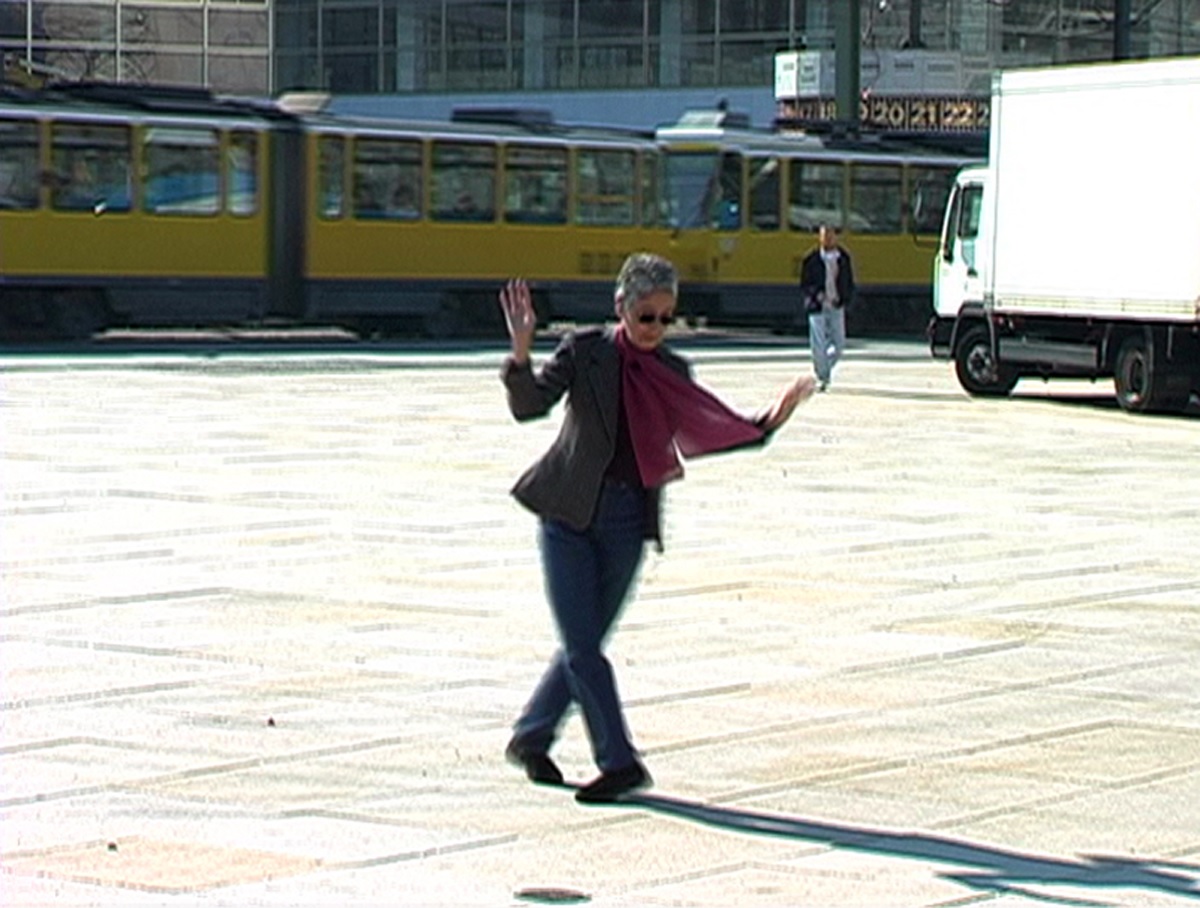 Adrian Moves to Berlin (2007 [Performance]/ 2017 [Video Wall Projection];
01:02:33):
What different drummer was that little old lady grooving to during lunch hour on Monday, 26 March 2007,
at Alexanderplatz in Berlin? Mystery Solved! An endurance task performance consisting in one hour of
continuous
improvisatory dance to selected Berlin house music of the early 2000s. The work is an example and a
celebration
of work, dedicated to East Berlin as the capital of the former state that was itself dedicated to the worker.
It
also celebrates my relocation to the city of reunification, in which two formerly segregated societies are
finding intelligent ways to come together. In Berlin, dance spaces have been one of those ways since the Fall
of
the Wall in 1989.
Adrian Moves to Berlin (2007 [Performance]/ 2017 [Video Wall Projection];
01:02:33):
What different drummer was that little old lady grooving to during lunch hour on Monday, 26 March 2007,
at Alexanderplatz in Berlin? Mystery Solved! An endurance task performance consisting in one hour of
continuous
improvisatory dance to selected Berlin house music of the early 2000s. The work is an example and a
celebration
of work, dedicated to East Berlin as the capital of the former state that was itself dedicated to the worker.
It
also celebrates my relocation to the city of reunification, in which two formerly segregated societies are
finding intelligent ways to come together. In Berlin, dance spaces have been one of those ways since the Fall
of
the Wall in 1989.
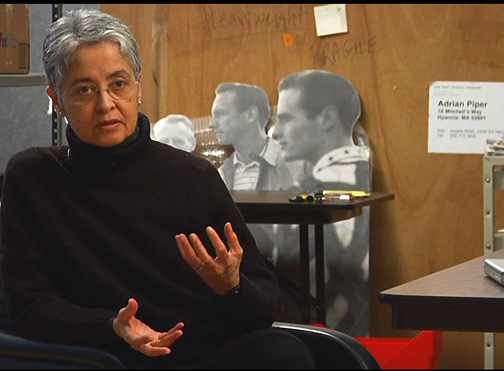 OPEN ACCESS. Adrian Piper Interview: Rationality and the Structure of the Self by
Robert Del Principe (2007-2010; 00:61:43). Thirty-four years in the making,
Rationality and the Structure of the Self was finally accepted for publication by Cambridge
University
Press after more than thirty referees had refused to read it. The first edition of both volumes appeared
here
as two open-access e-books in May 2008. Robert Del Principe asks candid questions, both pertinent and
impertinent, about their history, content and implications. With German subtitles. Click on image to watch entire video.
OPEN ACCESS. Adrian Piper Interview: Rationality and the Structure of the Self by
Robert Del Principe (2007-2010; 00:61:43). Thirty-four years in the making,
Rationality and the Structure of the Self was finally accepted for publication by Cambridge
University
Press after more than thirty referees had refused to read it. The first edition of both volumes appeared
here
as two open-access e-books in May 2008. Robert Del Principe asks candid questions, both pertinent and
impertinent, about their history, content and implications. With German subtitles. Click on image to watch entire video.
 OPEN ACCESS. Second Wave Feminism: Unfinished Business (2014; 01:49:41.
Lecture/Discussion). Talk delivered to the National Academy of Art, Oslo, to
commemorate the centennial anniversary of women’s suffrage in Norway. I reflect critically on the progress –
and lack of it – on women’s rights since then, with particular attention to the failure of second wave
feminism to address two interconnected foundational problems that obstruct its progress: first, the
persistence of internecine multi-level competition among women; and second, the coerced ritual conditioning
of
men. I offer some suggestions as to how these problems might be solved. The second half of the video
consists
in a very worthwhile audience discussion inflected by continuing local debate about the meaning of the mass
murders and bombings in Norway in 2011. Click on image to watch entire
video.
OPEN ACCESS. Second Wave Feminism: Unfinished Business (2014; 01:49:41.
Lecture/Discussion). Talk delivered to the National Academy of Art, Oslo, to
commemorate the centennial anniversary of women’s suffrage in Norway. I reflect critically on the progress –
and lack of it – on women’s rights since then, with particular attention to the failure of second wave
feminism to address two interconnected foundational problems that obstruct its progress: first, the
persistence of internecine multi-level competition among women; and second, the coerced ritual conditioning
of
men. I offer some suggestions as to how these problems might be solved. The second half of the video
consists
in a very worthwhile audience discussion inflected by continuing local debate about the meaning of the mass
murders and bombings in Norway in 2011. Click on image to watch entire
video.
All proceeds from the sale, rental, exhibition, publication or production of work by Adrian Piper support the APRA Foundation Berlin (APRA), a research archive and website at adrianpiper.com established for the benefit of those students, scholars, curators, collectors, writers, and members of the general public who have a constructive curiosity or scholarly or professional interest in Piper’s work in art, philosophy and yoga. APRA aims to contribute over the long term to a more balanced comprehension of the conditions of production of Piper’s entire body of work as a unified whole, by funding research that exemplifies, models, analyzes and/or theorizes the creative multi-disciplinary expressions of the self encouraged by globalization and cross-cultural journeying.